Resistance Bands vs Free Weights in a Small Space
How resistance bands and free weights compare for a small home gym on space, cost, noise, progress and exercise choice, and how to combine them for a complete setup.
Disclosure: Product links on this site aren't affiliate links: we don't earn anything from them today. If that changes, we may earn a commission at no extra cost to you, and this note will say so. Parts of this article were drafted with AI assistance and edited before publishing. Read our disclaimer.
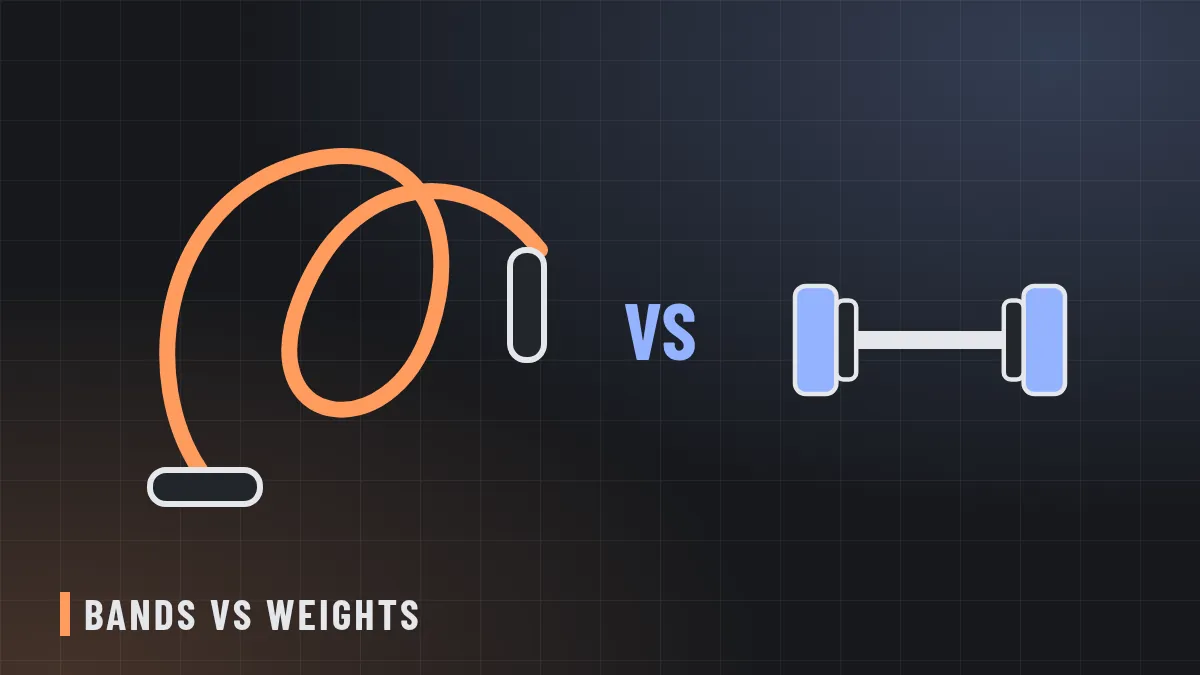
Bands win on space, cost, noise and portability; free weights win on measurable progress and heavy lower-body work. For a small home gym the best answer is usually both: a pair of adjustable dumbbells for the main lifts, and a set of bands for pulling, warm-ups and the days you train somewhere else.
This comparison is research-based and general, drawing on manufacturer specifications and the U.S. Physical Activity Guidelines for Americans, which list working with resistance bands alongside weight training as muscle-strengthening activity. It isn't a hands-on test of specific products. Prices are rough ranges for new gear in the U.S.; check the current price.
The short version
| Feature | Resistance bands | Free weights (dumbbells, kettlebells, barbells) |
|---|---|---|
| Space | Fits in a drawer | From one adjustable pair to a whole rack |
| Rough new price | Roughly $20–$50 for a set | Roughly $120–$500 for an adjustable dumbbell pair; much more for a barbell setup |
| Noise | Near silent | Quiet if set down gently; impact noise if dropped |
| Resistance | Increases as the band stretches | The same through the whole movement |
| Tracking progress | Approximate; bands are labeled differently by each maker | Exact: the number on the weight |
| Heavy leg work | Hard to load heavily | Easy to load progressively |
| Pulling exercises | Easy with an anchor | Rows yes; vertical pulling needs a pull-up bar |
| Travel | Excellent | Not really |
How bands work (and why it matters)
A band gets harder the more you stretch it. In a squat or a press, that means it's lightest at the bottom, where you're usually weakest, and heaviest at the top. That's useful for some exercises and less useful for others. It also means the "resistance" printed on a band is a range across a stretch, not a single number, and color codes and ratings aren't standardized between brands. Compare bands from the same maker, and log your progress by band and by how far you stood from the anchor.
The main types
- Tube bands with handles: usually sold as a set with a door anchor. Good for presses, rows, curls and anything that mimics a cable machine.
- Long loop bands (power bands): large flat loops. Good for assisted pull-ups, pull-aparts, band-resisted pushups and adding resistance to a barbell (an advanced use).
- Mini bands: short loops worn around the thighs or ankles for hip and glute warm-ups.
Where bands beat free weights
- Space and storage. A whole set hangs on one hook.
- Noise. There's nothing to drop, which makes bands ideal for early mornings, late nights and upstairs apartments.
- Pulling movements. Anchored in a door or around a rack post, bands give you rows, face pulls and pulldowns, which dumbbells can't fully replace without a pull-up bar.
- Assisted pull-ups. A loop band over a pull-up bar takes some of your body weight, so you can build up to full reps.
- Warm-ups and shoulder work. Light bands are a gentle way to warm up before lifting.
- Cost and travel. A set costs less than one pair of mid-weight fixed dumbbells and fits in a suitcase.
Where free weights beat bands
- Precise progress. Going from 25 to 30 lb is a clear, repeatable step. With bands, it's harder to know exactly how much more you're doing.
- Heavy lower-body work. Squats, deadlifts and lunges get heavy quickly. Dumbbells and barbells load your legs far more easily than bands.
- Consistent resistance. Weights resist through the whole movement, including the bottom, where bands go slack.
- Simplicity. No anchors, no stance adjustments: pick up the weight and lift it.
Small-space combinations that work
- The drawer gym (budget around $50–$100): a set of tube bands with a door anchor, a long loop band and a mat. Good for staying active and building a base.
- The corner gym: adjustable dumbbells (see adjustable vs fixed), a band set and a doorway pull-up bar. Covers every movement pattern in about a 6 × 6 ft area.
- The spare-room gym: add a bench, and you can run our beginner dumbbell routine with band rows or pull-aparts on top.
Enter your room in the Home Gym Planner to see which of these fits, or read what to buy first for the full priority order.
Band safety basics
- Inspect before every use. Look for nicks, thin spots, tears or sticky, cracked rubber. Replace any damaged band.
- Anchor securely. Use a solid anchor point with no sharp edges. With a door anchor, put it on the hinge side, make sure the door opens away from you so pulling closes it, and lock the door if you can.
- Control the return. Let the band shorten slowly instead of letting it snap back.
- Keep your face out of the line of pull in case a band slips or breaks.
- Store bands out of sunlight and heat, and out of reach of children and pets.
More in our home gym safety checklist.
Can resistance bands replace weights?
For general fitness, staying active and many upper-body exercises, bands can do a lot, and the Physical Activity Guidelines count band work as muscle-strengthening activity. For heavy lower-body training and precise progress, free weights are easier to load, so many people combine the two.
Are resistance bands good for small apartments?
Yes. They take almost no space, make very little noise and there's nothing to drop, which makes them one of the most neighbor-friendly ways to strength train.
How do I know how much resistance a band gives?
Makers list a range, usually tied to how far the band is stretched, and color codes aren't standard across brands. Compare bands from the same maker, and track your progress by band and stance rather than by an exact weight.