What Ceiling Height Do You Need for a Home Gym?
How to work out whether you can overhead press, fit a power rack or do pull-ups under your ceiling, with the simple formula our planner uses and fixes for low ceilings.
Disclosure: Product links on this site aren't affiliate links: we don't earn anything from them today. If that changes, we may earn a commission at no extra cost to you, and this note will say so. Parts of this article were drafted with AI assistance and edited before publishing. Read our disclaimer.
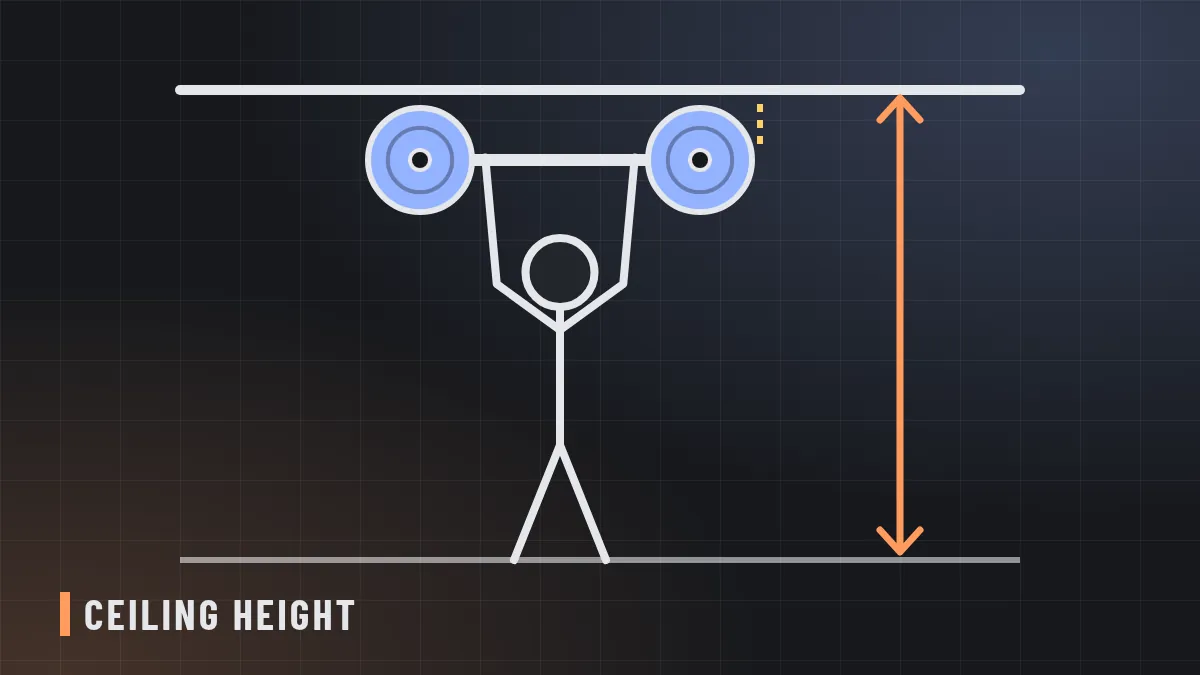
For most people, the ceiling only matters for three things: pressing a barbell overhead while standing, fitting a full-height power rack, and doing pull-ups on top of one. A standard 8 ft ceiling handles a lot of home gym work, but standing barbell presses are often out of reach unless you're on the shorter side.
The numbers here are rules of thumb, not building or equipment standards. They're the same ones our Home Gym Planner uses, and it will run them for your height and ceiling.
Step 1: Know your real ceiling height
Measure at the lowest point over where you'll train. Beams, ducts, light fixtures and ceiling fans all count. In a garage, check with the door open, because the door and the opener rail usually hang below the ceiling.
Many U.S. homes have 8 ft ceilings, newer homes often have 9 ft, and basements are frequently lower, sometimes around 7 ft, with beams or ducts lower still.
Step 2: Know your overhead reach
Stand flat-footed and reach both arms straight up; measure from the floor to your fingertips. If you can't measure, a common estimate is about 1.33 × your height. For someone 5 ft 10 in (70 in), that's about 93 in, or 7 ft 9 in, before you lift anything.
Overhead press: the formula
To find the highest point of a barbell at the top of a standing press, add up:
- Your overhead reach, minus about 3 in, because the bar sits in your palm below your fingertips.
- About 8.9 in for the plates. Full-size 45 lb and 20 kg plates are about 450 mm (17.7 in) across, so they stick up about half that above the bar.
- About 1.75 in for a 3/4 in rubber mat and your shoes.
- A couple of inches of breathing room so you're not grazing the ceiling.
For the 5 ft 10 in lifter: 93 − 3 + 8.9 + 1.75 + 2 = about 103 in, or about 8 ft 7 in. That's why standing barbell presses often don't work under an 8 ft ceiling.
Dumbbells need less: swap the 8.9 in for roughly 4 in of dumbbell head, and the same lifter needs about 98 in, which is right at the edge for an 8 ft (96 in) room.
| Your height | Estimated reach | Barbell press needs about | Dumbbell press needs about |
|---|---|---|---|
| 5 ft 2 in (62 in) | 82 in | 7 ft 8 in | 7 ft 3 in |
| 5 ft 6 in (66 in) | 88 in | 8 ft 1 in | 7 ft 9 in |
| 5 ft 10 in (70 in) | 93 in | 8 ft 7 in | 8 ft 2 in |
| 6 ft 2 in (74 in) | 98 in | 9 ft 0 in | 8 ft 7 in |
These are estimates from the formula above, including the 2 in margin. Arm length varies, so measure your own reach, or try the movement slowly with an empty bar or light dumbbells before you buy.
Power racks and squat stands
Full-height power racks are typically listed at roughly 80 to 93 in tall, and several brands make shorter versions in the low 70s for basements and low garages. Leave at least an inch above the rack, and remember you may need extra room to tip it upright during assembly; check the manual.
Squat stands are often shorter than racks and many have adjustable heights, which can make them easier to fit. If you plan to lift alone, choose stands or a rack with spotter arms or safety straps.
Pull-ups
On top of a rack, you need roughly a foot (12 in) above the pull-up bar so your head clears when your chin goes over. Under an 8 ft ceiling that only works with shorter racks. Alternatives:
- A doorway pull-up bar, which doesn't depend on ceiling height. Check it suits your door frame.
- A wall- or ceiling-mounted bar, which must go into studs or joists. Renters should ask the landlord first.
Low ceiling? Train around it
- Press seated. A seated dumbbell or barbell press takes a foot or more off the height you need.
- Press dumbbells instead of a barbell. No plates sticking up.
- Try a landmine press. One end of the bar sits on the floor, so the other end travels up and forward instead of straight up.
- Use smaller plates for light presses. Small-diameter plates sit lower, but they're only practical at light weights.
- Press outside. On a nice day, a driveway or patio has unlimited headroom.
Is an 8 foot ceiling high enough for a home gym?
For most things, yes: dumbbells, benches, squat stands and many power racks fit under 8 ft. Standing barbell overhead presses with full-size plates usually don't fit unless you're shorter than about 5 ft 5 in, so press seated or with dumbbells instead.
What ceiling height do I need for pull-ups on a power rack?
Roughly the height of the rack plus about 12 inches for your head. With full-height racks of about 80 to 93 in, that means a ceiling of about 7 ft 8 in to 8 ft 9 in or more.
How do I estimate my overhead reach?
Measure it if you can: stand flat-footed with both arms straight up and measure from floor to fingertips. As a rough estimate, overhead reach is often about 1.33 times your height.
Plug your own numbers into the Home Gym Planner for an instant check, and read how much floor space you need next.